
Reviewed · AUDIO TOURS
Downtown Vienna: A Self-Guided Audio Tour
Vienna sounds different when you walk it. This self-guided audio tour links together major downtown sights, from imperial power centers to modern architecture, using GPS and offline audio so you can move at your pace. I especially liked the mix of Spanish Riding School tradition and the stop focused on the Jewish community and the Holocaust memorial, because it makes the story feel human, not just monumental. One thing to plan for: you bring your own smartphone and headphones, since those are not included.
The route is built for a relaxed stroll, around 1 to 1.5 hours, starting at Heldenplatz and ending at Michaelerplatz. If you want Vienna with fewer lines and less guessing, the offline maps and audio help a lot, especially when streets start to look the same (they don’t, but they feel like it after a few turns).
In This Review
- Key Points You’ll Notice Right Away
- Start at Heldenplatz, Then Walk Vienna in Audio Chapters
- Prince Eugene and the Imperial Square Mood Setters
- The Imperial Palace Complex: Courtyards, Facades, and the “Why” Behind Them
- Spanish Riding School and Lipizzaner Tradition in Baroque Form
- Joseph II’s Bronze Statue and a City That Loves Ideas
- St Stephen’s Cathedral: 700 Years of Triumph and Trouble
- War and Fascism Memorials, Then the Habsburg Burial Vault
- A Market Square Feel, the Plague Column, and Strolling Vienna’s Shopping Street
- End at Michaelerplatz and the Looshaus Controversy
- Price and Value: What $14.99 Gets You in a 90-Minute Walk
- Should You Book This Downtown Vienna Audio Tour?
- FAQ
- FAQ
- How long is the Downtown Vienna self-guided audio tour?
- Where does the tour start and where does it end?
- What is the price per person?
- What languages are available?
- Do I need a smartphone or headphones?
- Can I use the tour offline?
- Is the tour private?
- Are there set visiting hours?
- What is included in the tour purchase?
Key Points You’ll Notice Right Away
- A GPS-led route starting at Heldenplatz and ending at Michaelerplatz, so you spend time seeing, not searching
- Imperial highlights in one loop, including the Spanish Riding School and the Habsburg burial site
- Emperor Joseph II’s story in a real city square, connected to visible monuments you can’t miss
- Remembrance stops tied to Vienna’s Jewish community, including the city’s first Holocaust memorial
- A dramatic architectural finale at the Looshaus, sparked by controversy back in 1909
- Offline audio, maps, and geodata, which makes the tour easier to rely on outdoors
Start at Heldenplatz, Then Walk Vienna in Audio Chapters
This is a self-guided experience, so you’re not waiting for a group. You’ll stand at the starting point on Heldenplatz (1010 Wien), load the VoiceMap app on your phone, and follow the GPS-driven instructions stop by stop. The audio is already set up for the walking rhythm of downtown Vienna, so it feels like you’re moving through a guided script, just without anyone holding the pace hostage.
Timing is straightforward. The tour is listed at about 1 hour to 1 hour 30 minutes, which is a good match for the city center density. You can probably keep it tight if you move briskly. If you pause for photos, read stone plaques, or just stop to take in views from the squares, it stretches naturally into the longer end.
The practical win is offline access. You get offline audio, maps, and geodata, meaning you’re less dependent on signal. That matters in Vienna, where you might step in and out of spots with patchy reception, or where you just don’t want to drain your data plan.
Other ways to round out a Vienna visit
Prince Eugene and the Imperial Square Mood Setters
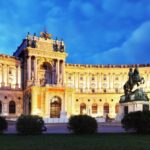
The tour kicks off with a big, showy presence: a bronze statue of Prince Eugene on horseback. It’s the kind of landmark that immediately tells you you’re in the center of imperial staging, not just a casual sightseeing circuit. The audio frames him as a military hero who defeated the Ottoman Empire, and that context helps you read the scale and confidence of the square around you.
From there, you’re led toward the imperial palace complex. You’ll spend time walking through the courtyards and facades tied to Habsburg rule across more than 600 years. Even if you’ve never cared much about dynasties before, this part is helpful because the audio connects what you’re seeing to how rulers actually used space: formal approach routes, ceremonial courtyards, and the feeling of power made visible in stone and design.
A possible drawback here is also the self-guided nature. If you prefer a live person answering questions, you might wish you could ask follow-ups when you hit something confusing. The audio does its job as a narrator, but it can’t react to your curiosity in real time.
The Imperial Palace Complex: Courtyards, Facades, and the “Why” Behind Them
When the route describes the imperial palace as a complex that served as the imperial seat for over 600 years, it’s not just name-dropping. This is your chance to understand why these places feel different from a normal palace visit. Courtyards in particular change how you experience a building. They give you small breaks where the city feels like it’s holding its breath between major spaces.
You’ll get a sense of the Habsburg empire as something broader than Vienna. The audio frames the empire as reaching across Central Europe, which helps you understand why Vienna became the kind of capital that attracted art, politics, and cultural ambitions. In other words, you’re not only seeing architecture, you’re seeing the logic of capital power.
If you’re short on time, this is one of the best sections to keep moving through at a steady pace. The route covers multiple exterior and courtyard perspectives, so you still get variety even if you do not go deep into every side room.
Spanish Riding School and Lipizzaner Tradition in Baroque Form
Next comes the Spanish Riding School area, introduced through the baroque setting where Lipizzaner stallions have performed for centuries. Even if you don’t catch a show, this stop is still worth it because it places the tradition in the building environment where it developed.
What I like about this part of the tour is the way it helps you respect the “living tradition” angle. It’s not just an old building. It’s a place connected to refined equestrian arts, and the audio encourages you to look at the setting as part of the discipline, not just a backdrop.
Practical note: because this is an audio route, it’s best paired with your own plan for any inside ticketed attractions. The tour itself doesn’t include entry fees for attractions not part of the walk, so if you want performances or additional interiors, you’ll need to plan and pay separately.
Set your own pace through the center
- Vienna: Schlumberger Wine Cellar Guided or Self-Guided Tour★ 4.8 · 285 reviews
- Vienna: Scavenger Hunt Self-Guided Tour★ 4.7 · 83 reviews
- Vienna: The Great Plague Exploration Game★ 4.5 · 60 reviews
- Vienna Walking Tour with Audioguide on Your Smartphone★ 4.0 · 52 reviews
Joseph II’s Bronze Statue and a City That Loves Ideas
Then you hit the bronze statue of Emperor Joseph II, the “enlightened ruler” described as shocking subjects by abolishing serfdom. This is a smart stop because it makes politics feel physical. You’re not reading about reforms in a book. You’re standing in public space, looking at a monument tied to real, disruptive change.
The tour’s pacing here also helps. After the formality of imperial architecture, you’re now in a more conversational area where discussion about ideas can land. You’ll walk through a peaceful square while the audio frames Joseph II as part reformer, part controversial figure. That balance matters, because it stops Vienna from becoming only a glossy postcard.
From there, you’ll pass a baroque facade of one of the world’s most beautiful libraries. The audio points you toward what’s important, knowledge housed inside ornate walls. Even without naming every room, you’ll leave with the right mental image of a city that treated learning and administration like core state responsibilities.
St Stephen’s Cathedral: 700 Years of Triumph and Trouble
The next major landmark is St Stephen’s Cathedral, described as a towering Gothic masterpiece with the distinctive diamond-patterned roof tiles. This is one of those sights where the audio helps you look up in the right way. You stop seeing a single landmark and start noticing how the cathedral has witnessed turning points across centuries.
The tour frames it as a church that has seen 700 years of Vienna’s triumphs and tragedies. That phrasing matters because it nudges you to keep perspective. A big cathedral isn’t only about beauty. It’s also about continuity in times when things were not stable.
If you’re trying to keep the walk manageable, this is a place where it pays to pause. Even if you don’t go inside, the exterior and roof details give you enough visual hooks to make the stop feel substantial.
War and Fascism Memorials, Then the Habsburg Burial Vault
A key part of this route is the memorial dedicated to victims of war and fascism. The audio asks you to reflect while you stroll past the modern sculpture. This is not the kind of stop that you rush. Even if you don’t love serious themes on vacation, this one anchors the tour so Vienna doesn’t become only imperial spectacle.
Right after remembrance, you walk by the modest entrance to the Habsburg family final resting place beneath the Capuchin Church. The tour notes that 150 members of the imperial dynasty lie in elaborate bronze coffins. That detail changes how you feel about a royal tomb. It’s not only about status. It’s also about the long shadow of death, preserved as part of the dynasty’s public image.
This section is emotionally intense in a quiet way. If you’re traveling with someone who prefers lighter content, it may help to tell them you’re about to hit a reflective portion of the walk. On the other hand, if you like context, this is a highlight because the route links political power to human consequence.
A Market Square Feel, the Plague Column, and Strolling Vienna’s Shopping Street
Next the tour guides you through a charming square where Viennese nobility once gathered for markets and celebrations. It’s the kind of stop that works best when you slow down enough to notice the texture of the place. Pavements and open spaces are where Vienna’s social story shows up, and the audio helps you imagine what everyday life might have looked like in earlier centuries.
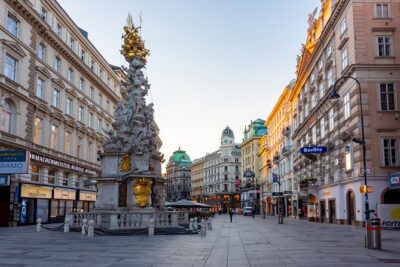
Then comes the dramatic baroque monument spiraling toward heaven with golden figures and cherubs. The tour explains it commemorates Vienna surviving the plague while also serving as a baroque statement of faith and fear. You’ll likely catch yourself looking up more than once here, because the design insists on attention.
After that, you’re led to Vienna’s most elegant pedestrian shopping street lined with baroque and Art Nouveau buildings. The point of this section is atmosphere. You’re not only ticking off sites. You’re walking through the kind of street scene that makes Vienna feel like a living museum, where design styles overlap and continue to shape everyday strolling.
End at Michaelerplatz and the Looshaus Controversy
The tour ends at the Looshaus, a modernist building that shocked Vienna in 1909 with its stark, undecorated facade. This ending is a clever move, because it contrasts the tour’s earlier heavy ornamentation with a design that deliberately refuses decoration.
The audio frames the building as an architectural rebel, and it even notes that Emperor Franz Joseph reportedly reacted angrily enough that the controversy became part of imperial Vienna’s lore. Whether you agree with the outrage or not, it helps you understand the real point: even in a city famous for classic elegance, people once fought over what “proper” design should look like.
You’ll finish at Michaelerplatz, with the end location listed as Michaelerplatz 5. It’s a practical ending point, close to the kind of downtown paths that make it easy to continue your day on foot.
Price and Value: What $14.99 Gets You in a 90-Minute Walk
At $14.99 per person, this tour isn’t trying to compete with paid guided group tours. It’s priced for what it is: a high-quality walking route you can reuse. You get lifetime access to the English tour before your booking date and after it, which is rare for city-center audio walking products. That means if you come back to Vienna later, you can repeat the walk without paying again.
The offline bundle adds real value. Most visitor frustrations in historic centers come from figuring out where to go next, losing signal, or burning battery on navigation. Having offline audio, maps, and geodata helps keep your day in motion.
There’s also one more value angle. The tour is private in the sense that it’s only your group, and since it’s self-guided, that usually translates to a lower stress level. You don’t have to find a time when everyone agrees, because your schedule is built into the route.
One past 5-star user highlighted that it’s super in-depth and informative, and praised the creator as a strong source on local urbanism and culture in Vienna and Budapest. That matches the feeling of the route: it’s not only about monuments, it’s about how the city works and why it grew the way it did.
Should You Book This Downtown Vienna Audio Tour?
Book it if you want a smart, walkable route through major Vienna landmarks without the friction of a live guide schedule. You’ll like it most if you enjoy architecture, want context for Habsburg power and Joseph II’s reforms, and don’t mind that remembrance stops are part of the story. The mix of imperial sites, the Capuchin burial vault, a memorial tied to victims of war and fascism, and the Holocaust memorial makes this feel honest, not one-note.
Skip it if your ideal tour is a live Q and A format or if you want included museum entry tickets. This is mainly about the outdoor walking route and the audio chapters connected to what you see. Also, set expectations for setup: you’ll need your own smartphone and headphones to hear it.
If you’re on a first Vienna trip and you want your city center route to feel organized, this is a good bet. You can use it as a backbone for the rest of your day, then branch out to whatever you feel like exploring next.
FAQ
FAQ
How long is the Downtown Vienna self-guided audio tour?
The tour is listed as about 1 hour to 1 hour 30 minutes.
Where does the tour start and where does it end?
It starts at Heldenplatz, 1010 Wien, Austria and ends at Michaelerplatz, with the end location listed as Michaelerplatz 5, 1010 Wien.
What is the price per person?
The price is $14.99 per person.
What languages are available?
The tour provides audio in English.
Do I need a smartphone or headphones?
Yes. A smartphone and headphones are not included, so you’ll bring your own.
Can I use the tour offline?
Yes. It includes offline access to audio, maps, and geodata.
Is the tour private?
It’s listed as a private tour/activity, meaning only your group participates.
Are there set visiting hours?
The opening hours shown for the booking window are 12:00 AM to 11:59 PM, Monday through Sunday.
What is included in the tour purchase?
Included items are lifetime access to the tour in English before your booking date and after it, GPS self-guided flexibility, directions to the starting point, the iOS and Android app, and offline access to audio, maps, and geodata.
Latest Additions
- Wachau Valley Private Wine Tour with Tasting and Gourmet Lunch
★ 5.0 · 1 review - Vienna: Danube Valley Tour with Melk, Dürnstein with wine tasting and boat.
★ 5.0 · 1 review - Private city tour in Vienna
★ 5.0 · 1 review - Hallstatt Small Group Day Trip from Vienna
★ 3.0 · 1 review - Inside Freud’s Mind: Self-Guided Mystery Walk in Vienna
★ 4.0 · 1 review - Private Transfer from Vienna to Prague
★ 5.0 · 1 review - Vienna’s Christmas Market Magic Tour
★ 5.0 · 1 review
Audio Tours, compared.
Tickets for Mozarthaus Vienna with Audio Guide
Read our review →
New Hofburg Palace Audio-Guided Tour & Entry Ticket
Read our review →
The Heart of Vienna: A Self-Guided Audio Tour
Read our review →
Vienna Scavenger Hunt and Highlights Self Guided Audio Tour
Read our review →Vienna Skip-the-line Ticket to Schonbrunn Palace with Audio Guide
Read our review →
Vienna Historic Center: City Walk with Audio Guide on your Phone
Read our review →Browse the lists this tour appears in